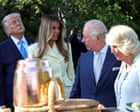
The scheduled meeting between King Charles III and Donald Trump represents a high-stakes convergence of constitutional preservation and volatile geopolitical signaling. This interaction functions as a stress test for the British monarchy’s neutrality principle, particularly as it precedes the King’s address to a joint session of Congress. The primary objective for the Palace is not diplomatic achievement, but rather the mitigation of "political contamination"—the risk that the crown becomes a prop in a domestic US political narrative or an accidental catalyst for partisan friction within the UK.
The Three Vectors of Constitutional Risk
Managing a state visit or an informal royal meeting involving a figure as polarizing as Donald Trump requires a three-dimensional risk assessment. Each vector carries specific costs if mismanaged.
- The Neutrality Vector: The British monarch serves as a symbolic unifying force. Direct engagement with a candidate or a political disruptor during an election cycle (or a period of high domestic tension) threatens the "bipartisan shield" that protects the monarchy from abolitionist or republican critiques.
- The Legislative Vector: The address to Congress is the formal center of gravity for this trip. If the meeting with Trump is perceived as an endorsement—or a snub—it risks alienating factions within the US House or Senate, potentially diluting the impact of the King’s speech or inciting a boycott by specific caucuses.
- The Protocol Vector: Off-camera meetings are a deliberate defensive tactic. By removing the visual record, the Palace retains control over the narrative, preventing the creation of campaign-ready imagery that could be used to imply a special alignment between the two figures.
The Strategic Logic of the Off-Camera Mandate
The decision to keep the meeting strictly private serves as a "media blackout" designed to lower the volatility of the event. In the context of game theory, the Palace is playing a minimax strategy: minimizing the maximum possible loss (a diplomatic or PR disaster) rather than seeking a high-reward public relations win.
The Information Vacuum Strategy
By denying cameras, the Palace creates a situation where any leaked details remain hearsay. In the absence of a visual "handshake moment," the media is forced to rely on official statements which are historically sanitized and brief. This creates a friction point for pundits who wish to spin the meeting into a political statement. The information vacuum acts as a buffer, ensuring that the King’s formal words to Congress remain the definitive record of the visit.
Mitigation of Symbolic Co-option
Donald Trump’s political brand relies heavily on the projection of strength and institutional validation. The British Monarchy, as the ultimate symbol of traditional authority, is a high-value asset for this brand. The "off-camera" constraint is a tactical refusal to lend that asset. It acknowledges the necessity of the meeting (likely driven by historical ties or long-term diplomatic hedging) while stripping it of its most potent political currency: the photograph.
The Cost Function of Diplomatic Timing
The timing of this encounter—occurring just before a major speech to the US legislature—introduces a significant "interference cost." To quantify this, one must look at the impact on the King's primary objectives.
- Speech Integrity: The address to Congress is intended to focus on shared Anglo-American values, climate initiatives, or defense cooperation. If the pre-speech news cycle is dominated by the Trump meeting, the core policy messages are buried.
- Partisan Polarization: The US Congress is currently defined by deep tribalism. A King who is seen "consorting" with a figure viewed as an existential threat by one half of the room—and a hero by the other—faces a narrowed path to a successful reception. The "cost" here is a divided audience, where applause becomes a metric of partisan alignment rather than a sign of international respect.
Mechanism of the Constitutional Constraint
The King does not act in a vacuum; he acts on the advice of his government. The Foreign, Commonwealth & Development Office (FCDO) provides the "operating parameters" for these interactions. The friction between Charles III and Trump is not merely a clash of personalities, but a clash of systems.
- Fixed vs. Fluid Power: The British Monarchy represents fixed power—permanent, slow-moving, and bound by centuries of precedent. The Trump movement represents fluid power—unpredictable, populist, and personality-driven.
- The Advice Buffer: Because the King acts on ministerial advice, the Palace can shift the "blame" for controversial decisions onto the elected government. This allows the King to maintain a personal rapport with a former (and potential future) president while the institution maintains its distance.
Structural Bottlenecks in Transatlantic Relations
This meeting highlights a growing bottleneck in the "Special Relationship." Historically, the relationship was anchored by institutional stability. As US politics becomes increasingly volatile, the British government must decide whether to anchor its strategy to the US State Department or to individual political figures.
The Royal Family acts as the "long-term hedge." While Prime Ministers come and go, the King remains. Meeting with Trump is an exercise in continuity—an acknowledgment that regardless of the 2024 or 2028 election outcomes, the UK must maintain channels with all potential centers of American power. The "clash" mentioned in the reference article is less about personal animosity and more about the technical difficulty of maintaining that hedge without triggered a domestic backlash in Britain.
Operational Limitations of the Palace PR Machine
The Palace’s ability to control the narrative is limited by the external actors' willingness to play by the rules. While the King can ban his own photographers, he cannot stop the other party from describing the meeting in their own terms via social media or press scrums immediately following the event.
This creates a "Narrative Asymmetry." The Palace will issue a one-sentence confirmation of the meeting. The Trump team may issue a multi-paragraph description highlighting warmth and agreement. The institutional preference for silence often leaves the Palace vulnerable to being defined by the louder party. To counter this, the FCDO often coordinates "background briefings" with select journalists to ensure the institutional perspective is represented in the second or third paragraph of every news story.
The Washington Calculus: A Two-Track Approach
While the Windsor meeting captures headlines, the actual diplomatic heavy lifting occurs on a parallel track in Washington. The King’s speech to Congress is the "A-Track"—formal, legislative, and permanent. The Trump meeting is the "B-Track"—informal, precautionary, and ephemeral.
The success of the trip depends on the B-Track not derailing the A-Track. If the King can navigate the Windsor summit with zero leaked footage and zero inflammatory quotes, he clears the runway for his address. If, however, the meeting produces a "hot mic" moment or a controversial social media post from the Mar-a-Lago camp, the Washington speech will be viewed through the lens of that controversy.
The Congressional Impact Matrix
| Stakeholder Group | Perception Risk | Strategic Mitigation |
|---|---|---|
| Progressive Democrats | View the King as validating a populist leader. | Emphasize the King's work on climate change and sustainability. |
| MAGA Republicans | View the King as part of a globalist elite. | Emphasize traditional values and historical military alliances. |
| Institutionalists | Fear the degradation of formal diplomatic norms. | Strict adherence to off-camera protocols and FCDO guidance. |
Strategic Recommendation for the Windsor Summit
To navigate the immediate friction, the Palace must execute a "Functional Engagement" model. This involves treating the meeting as a standard diplomatic necessity rather than a social event.
- Strict Temporal Control: Limiting the duration of the meeting to the absolute minimum required by protocol. A 20-minute meeting is a "courtesy"; a 90-minute meeting is a "discussion."
- Neutral Grounding: Ensuring the conversation remains tethered to non-controversial topics, such as the upcoming anniversary of the D-Day landings or shared charitable interests, which provide a safe "exit ramp" for official statements.
- Proactive Congressional Engagement: Before the King lands in Washington, his staff must have already socialized the "why" of the Trump meeting with key Congressional leaders to ensure there are no surprises that could lead to a floor protest or a cold reception.
The ultimate forecast for this interaction is one of managed tension. The friction is not a sign of failure, but a sign that the constitutional guardrails are functioning. By refusing to provide the visual and digital oxygen that political campaigns crave, the Monarchy protects its most valuable asset: its perceived distance from the temporary squabbles of the voting public. The focus must remain on the Congressional podium, as that is where the sovereign's voice carries the weight of the state, rather than the weight of a private conversation in a drawing room.
Ensure all pre-speech briefings to the US press corps emphasize the "Institutional Continuity" of the Monarchy. Any attempt by journalists to pivot toward the Trump meeting should be met with a standardized redirect toward the legislative objectives of the Congress address. The goal is to make the Trump meeting the most boring news item of the week through sheer lack of data.