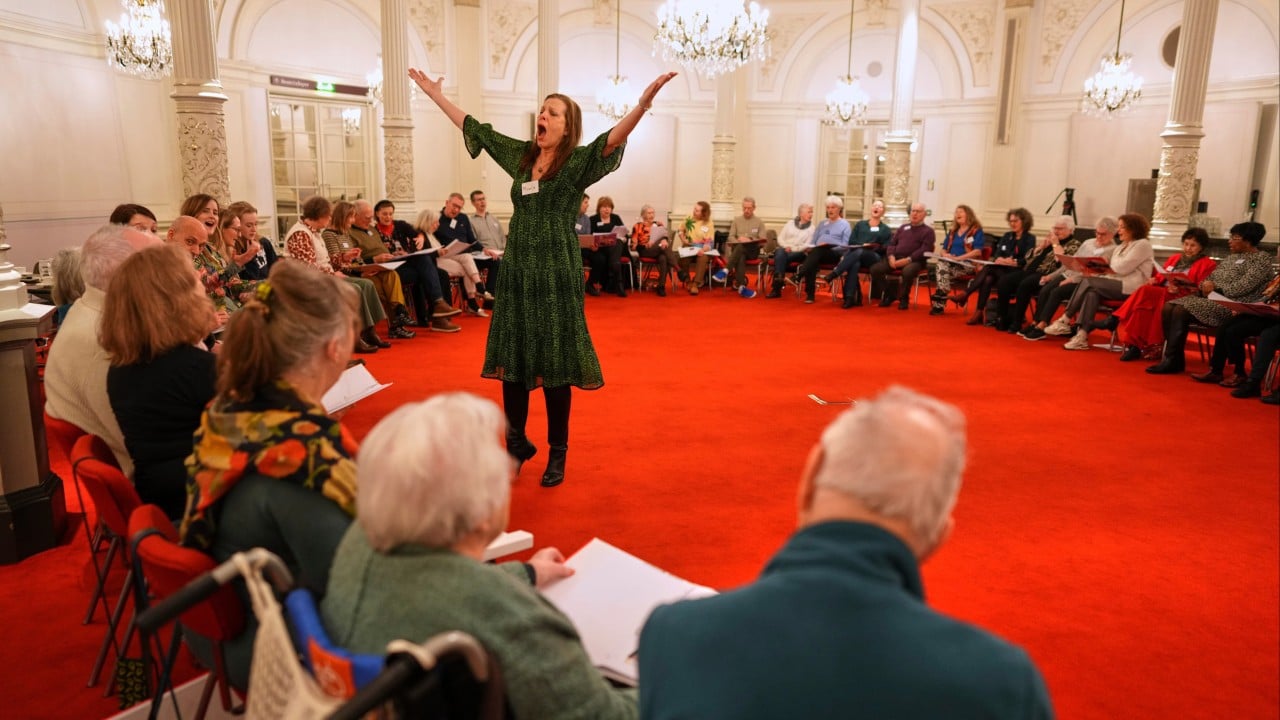
Music does not sit in a single corner of the human brain. It is a sprawling, decentralized network that often remains standing long after the structures governing short-term memory and verbal logic have crumbled. At Amsterdam’s Royal Concertgebouw, a program known as Spraakmakend (Remarkable) is testing the limits of this neurological resilience. By gathering people living with dementia and their caregivers into a singing circle within one of the world’s most acoustically perfect environments, the initiative moves beyond simple entertainment. It functions as a high-stakes clinical observation of how rhythmic and melodic cues can temporarily bypass damaged neural pathways to restore a sense of self.
This is not a story about "feeling better." It is a story about the systematic preservation of identity through sound. While much of the world treats dementia as a slow, inevitable erasure, the work being done in Amsterdam suggests that the "musical self" is far more durable than we previously understood.
The Neural Bypass of the Lyric
Neurologists have long observed a phenomenon where patients who can no longer string together a coherent sentence can still sing every word of a folk song learned in childhood. This occurs because musical memory is processed differently than episodic memory. While the hippocampus is often the first casualty of Alzheimer’s, the areas of the brain responsible for musical appreciation—the ventral pre-motor cortex and the medial pre-frontal cortex—frequently show significantly less atrophy in the early and middle stages of the disease.
When the group at the Concertgebouw begins to sing, they aren't just reminiscing. They are engaging in a form of cognitive "re-routing." The music acts as a scaffolding. Because singing requires a synchronized effort of breathing, vocalization, and rhythmic timing, it forces the brain to fire across multiple lobes simultaneously. For forty-five minutes, the fog of aphasia lifts. The person who struggled to name their spouse ten minutes earlier is suddenly hitting a high C in perfect time.
Why the Venue Matters
Acoustics are not a luxury in this context; they are a tool. The Concertgebouw is famous for its "shoebox" design and a reverb time that provides a warm, enveloping sound. For a person with dementia, sensory processing is often fractured. Background noise can be terrifying. Crowded rooms become a chaotic mess of indistinguishable signals.
The intentionality of the Concertgebouw’s space provides a "clean" auditory environment. In a standard community center or a linoleum-tiled hospital ward, sound bounces harshly, creating a sensory overload that can trigger agitation. In the Great Hall, the sound is rounded and clear. This allows the participants to focus entirely on the pitch and the person sitting next to them. The architectural excellence of the building serves as a stabilizer for a mind that is otherwise losing its grip on physical reality.
The Caregiver Crisis and the Social Mirror
We often focus on the patient, but the crisis of dementia is a two-headed beast. Caregivers—usually spouses or adult children—suffer from a unique form of "anticipatory grief." They are mourning someone who is still physically present but increasingly unreachable. The singing circle provides a rare moment where the caregiver can stop being a nurse and start being a partner again.
In most medical settings, the interaction is transactional: feeding, bathing, medicating. During the Spraakmakend sessions, the hierarchy of "sick" and "well" evaporates. When a husband sees his wife’s eyes light up as she recognizes a melody from their wedding, the clinical reality of the disease is suspended. This is a vital reprieve for the caregiver's own mental health, reducing the burnout that often leads to premature institutionalization.
The Limitations of Melodic Therapy
It would be dishonest to suggest that singing is a cure. It is a bridge, and like all bridges in the world of neurodegeneration, it eventually leads back to the same destination. The "lucidity" found during these sessions is fleeting. Often, within an hour of leaving the concert hall, the participant returns to a state of confusion.
Critics of these programs sometimes argue that the resources spent on high-end cultural experiences would be better used in direct medical research or primary care staffing. There is a valid tension here. Is a morning of song a meaningful intervention or merely a temporary distraction from a grim reality? The answer lies in the quality of life. If we cannot yet fix the hardware of the brain, the only remaining ethical path is to optimize the software of the human experience.
Moving Beyond Amsterdam
The success of the Amsterdam model highlights a massive gap in how other global cities handle aging populations. Most elder care is designed for safety and containment, not for the stimulation of dormant cognitive strengths. We build fences when we should be building stages.
The Concertgebouw program is scalable, but it requires a shift in how cultural institutions view their mandate. A museum or a concert hall is not just a vault for the past; it is a public health asset. Using these spaces to treat social isolation and cognitive decline should be a standard part of urban planning.
The data from these sessions shows a marked decrease in "sundowning"—the period of extreme agitation that hits many dementia patients in the late afternoon. By stimulating the brain’s reward centers and regulating the nervous system through group singing in the morning, the violent or panicked outbursts later in the day are often mitigated. This reduces the need for sedative medications, which carry their own risks of falls and further cognitive impairment.
The Mechanical Reality of Rhythm
Rhythm is perhaps the most primitive element of our biology. Our hearts beat in time; our lungs expand and contract in a cycle. In the later stages of dementia, when the ability to process complex melody fades, the response to a steady beat remains. This is why percussion is often integrated into these circles.
The motor cortex, which controls movement, is deeply tied to the auditory system. This is why we tap our feet without thinking. For a person whose motor skills are declining, the external beat of a drum or a piano provides a "metronome" for their own body. It helps them find their center in a world that feels increasingly off-balance.
The Economics of Empathy
If we look at this through a cold, fiscal lens, the Amsterdam experiment makes sense. The cost of a music program is a fraction of the cost of the psychiatric interventions required when a dementia patient becomes unmanageable. By investing in the "musical self," the healthcare system is actually hedging against the most expensive symptoms of the disease.
The Royal Concertgebouw isn't just hosting a choir; they are conducting a pilot study in how to keep humans human for as long as possible. The program challenges the notion that a diagnosis of dementia is a social death sentence. It proves that the personality is not gone; it is simply trapped behind a malfunctioning interface.
Look at the hands of a participant who hasn't spoken in a week. Watch them start to conduct the air as the violins begin. That movement isn't a reflex. It is a choice. It is the brain asserting its existence through the only medium it has left.
Ask your local cultural council why your city's greatest halls are empty on Tuesday mornings while your elderly are staring at white walls in a ward.