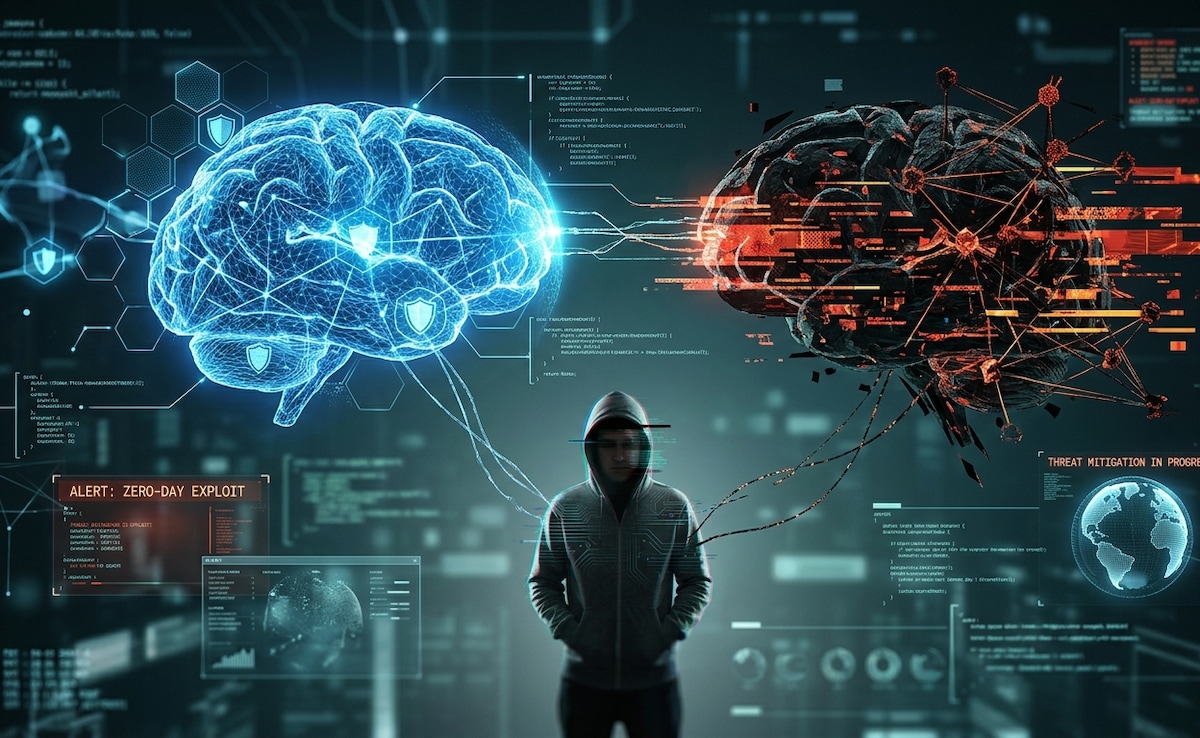
The current state of cybersecurity has moved past the era of manual intrusion. We are now witnessing a high-speed collision between autonomous offensive agents and machine-led defense systems that operate at a tempo no human brain can track. While the industry fixates on the novelty of Large Language Models, the real danger lies in the silent, automated feedback loops that allow malware to rewrite its own source code to evade detection in milliseconds. The primary failure of modern security isn't a lack of processing power; it is the persistent belief that a human being should remain "in the loop" for critical decision-making. In a fight where the enemy moves at the speed of light, waiting for a manager to click "approve" is a suicide pact.
The Myth of the Level Playing Field
The common narrative suggests that AI-driven defense will eventually catch up to AI-driven offense. This is a fundamental misunderstanding of the physics of software. In every other theater of war, the defender has the advantage of the high ground or fortified positions. In cyberspace, the defender must be right 100% of the time across a sprawling, decaying surface of legacy code and unpatched hardware. The attacker only needs to be right once.
Automation scales this imbalance to a terrifying degree. When an attacker uses a machine to find vulnerabilities, they aren't just looking for one door; they are knocking on ten million doors simultaneously. Defensive AI, by contrast, is often shackled by the fear of "false positives." If a security tool incorrectly identifies a critical business process as a virus and shuts it down, the security team gets fired. This creates a built-in hesitation—a digital friction—that the offensive side simply does not have. Attackers do not care about collateral damage.
The Weaponization of Adaptive Code
We are seeing the rise of "polymorphic" threats that use machine learning to observe how they are being caught. Imagine a piece of ransomware that enters a network and deliberately triggers a minor alarm. It watches which defensive tool responds, analyzes the signature used to identify it, and then mutates its own underlying structure to bypass that specific tool.
This isn't a theory. We have observed instances where malware utilizes basic logic gates to "fingerprint" the environment. If it senses it is in a sandbox—a virtual trap set by researchers—it remains dormant or performs mundane tasks like checking the weather. The moment it hits a live production server, it activates. The integration of neural networks into these packages allows them to guess passwords and social engineer employees with a success rate that makes traditional phishing look like a joke.
Why Human Intuition is a Liability
For decades, we have been told that the "human element" is the ultimate safeguard. That is a lie told by companies that cannot afford to fully automate. In a live breach, a human analyst takes an average of 20 to 30 minutes to verify an alert, correlate the data, and take action. An automated exploit can exfiltrate an entire database in less than 45 seconds.
The cognitive load on security professionals has reached a breaking point. They are bombarded by thousands of alerts daily, most of which are noise. This leads to "alert fatigue," a state of mental numbness where the one signal that actually matters gets buried under a mountain of triviality. When you introduce AI into this mix, you often just create more sophisticated noise for the humans to sort through.
The bottleneck is our biological limitation. We cannot read logs at the speed of a fiber optic connection. We cannot visualize the connections between ten thousand disparate IP addresses in real-time. By insisting that a human must oversee every automated response, we are effectively slowing down our machines to match the pace of a tired person drinking lukewarm coffee at 3:00 AM.
The Hidden Cost of the Black Box
The most significant risk in this automated arms race is the "Black Box" problem. Most modern defensive AI models are based on deep learning. They are effective, but their creators often cannot explain why the machine made a specific decision.
If a defensive system decides to shut down a power grid or a hospital's internal network because it detected a "potential" threat, we need to know the reasoning. Without "Explainable AI," we are handing the keys to our civilization over to algorithms that act on correlations we don't understand. This creates a new kind of vulnerability: adversarial machine learning.
Smart attackers are now learning how to "poison" the data that defensive systems use to learn. By feeding a security AI subtle, distorted information over several months, an attacker can train the system to ignore a specific type of malicious behavior. It is the digital equivalent of slowly gaslighting a guard until he thinks a thief is just a coworker.
The Failure of the Perimeter
The old model of "castle and moat" security is dead, yet many organizations still spend millions trying to build higher walls. In an era of automated probing, your perimeter is effectively nonexistent. The attack surface is every smartphone, every smart lightbulb, and every remote worker's home router.
Automated tools are now expert at "living off the land." This means they don't bring their own suspicious tools into your network. Instead, they use the legitimate administrative software already present—like PowerShell or WMI—to carry out their mission. Since these tools are supposed to be there, traditional antivirus software doesn't blink. AI-driven defense must move toward "Zero Trust" architectures where every single action, no matter how small or "trusted," is treated as a potential breach.
The Economic Engine of the Underground
We must look at the money. The reason the offense is winning is that the ROI for a successful hack is astronomical compared to the cost of the tools. You can now buy "Ransomware as a Service" (RaaS) on the dark web for a small fee or a percentage of the profits. These kits come with 24/7 technical support and automated dashboards.
The bad guys have better customer service than most legitimate software vendors.
On the defensive side, companies are drowning in "technical debt." They are trying to protect modern AI-driven assets using infrastructure built in the 1990s. You cannot defend a cloud-native environment with a legacy firewall. The cost of upgrading is high, but the cost of a total systemic collapse is terminal.
The Sovereignty of the Algorithm
As we move forward, we are going to see "Autonomous Security Operations Centers" (ASOCs). These will be environments where the machines are given full agency to fight back. This includes "Active Defense"—a polite term for hacking the hackers.
There is a massive legal and ethical gray area here. If an American company's AI automatically counter-attacks a server in a third-party country to stop a data breach, and that server turns out to be a hijacked hospital system, who is liable? The lack of international norms for automated cyber warfare is a vacuum that will eventually be filled by a catastrophe.
The Hard Truth of Survival
Security is not a problem that can be "solved." It is a continuous state of decay that must be managed. If you are waiting for a software update that will make your organization unhackable, you have already lost.
The organizations that survive the next decade will be those that accept the following:
- Total Automation is Mandatory: If your response time isn't measured in milliseconds, you aren't defending; you're just performing an autopsy.
- Assume Breach: Stop trying to keep them out and start assuming they are already in. Focus on making your data useless to them through ubiquitous encryption.
- Remove the Human Bottleneck: Move humans to a strategic role. Let the machines handle the tactical fight.
- Audit the AI: Spend less time watching the network and more time auditing the logic of the machines you've hired to watch the network.
The era of the "script kiddie" is over. We are now in the age of the "ghost in the machine," where wars are won and lost before a human even realizes the first shot was fired. If we continue to prioritize our own comfort and "oversight" over the raw speed of automated defense, we aren't just the weakest link—we are the broken one.
Stop treating cybersecurity as an IT expense. It is the fundamental floor upon which your entire business sits. If the floor is made of sand, it doesn't matter how beautiful the building is. Build for the speed of the machine, or prepare to be buried by it.