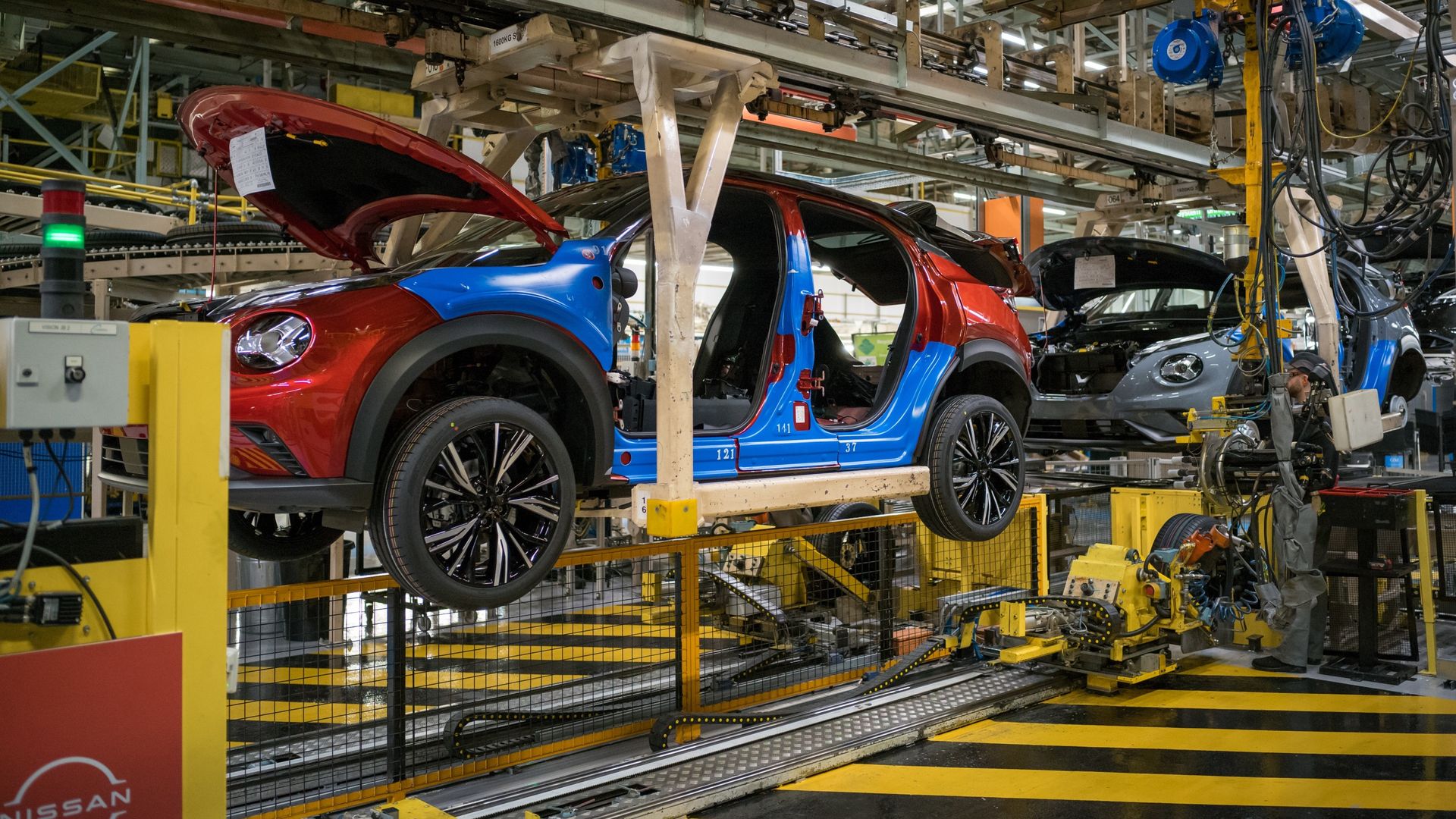
Nissan will consolidate its two manufacturing lines into a single line at its flagship Sunderland plant, triggering a wider European restructuring that slashes 900 corporate and office jobs, roughly 10% of its regional workforce. While the company insists that shop-floor manufacturing roles in the UK will be spared by moving the remaining line to a three-shift pattern, the consolidation exposes a deep systemic crisis. The plant is currently operating at roughly 50% capacity, building just 273,174 vehicles last year compared to its historic peak of over half a million. This scaling back represents a major retreat in the face of aggressive Chinese competition and plunging domestic market share.
For decades, the Sunderland facility stood as the jewel in the crown of British manufacturing. It was a hyper-efficient powerhouse that proved a Japanese automaker could outwork and out-build anyone in Europe. Today, that narrative is fracturing under the weight of global market shifts and brutal corporate balance sheets. In related news, read about: The Help Wanted Sign That Refuses to Fade.
The Empty Spaces on Line One
Corporate public relations units are highly skilled at framing a retreat as an optimization strategy. Nissan calls the consolidation of its Tyne and Wear facility an effort to reduce complexity under its global recovery blueprint. The reality is far simpler and much more damaging.
The factory has been running cold. The Wall Street Journal has also covered this important issue in extensive detail.
When an automotive assembly plant drops to half-capacity, it eats capital alive. Line One and Line Two were chewing through money because neither had the volume to justify its footprint. Merging them into a single line running three shifts is an act of industrial triage.
The company claims no factory floor jobs will go in Sunderland because the workers from the shuttered line will simply be absorbed into the extra shifts on the remaining line. Experienced industry analysts know that this is a temporary shield. When you shrink your manufacturing footprint, your long-term staffing requirements inevitably contract. Even if assembly workers stay on the line today, the white-collar support staff, administrative workers, and regional office personnel across the UK and Europe are taking the immediate hit.
The restructuring extends far beyond the English northeast. Nissan is downsizing its Barcelona parts warehouse and abandoning direct distribution in Nordic countries, retreating instead to an outsourced importer model. It is the footprint of a company in structural contraction.
The Chinese Influx and the Market Share Bleed
To understand why Nissan is closing a production line in the UK, look at the registration data on the docks of British ports. The company's UK market share has collapsed to 3.7% in the first part of this year, down from 5.6% a decade ago. Its sales in the European Union dropped 8.3% in the first quarter alone.
The market did not shrink. The buyers just went elsewhere.
Chinese automotive groups are no longer an oncoming threat; they are winning the market share battle in real time. Chery, which handles the Omoda and Jaecoo brands, has captured a 6% share of the UK market. BYD is rising fast at 3.5%, sitting almost level with Nissan. These state-backed operations move with a speed and vertical integration that legacy Japanese manufacturers are struggling to match.
Nissan invested £450 million to upgrade Sunderland for the new electric Leaf, alongside future plans for electric versions of the Juke and Qashqai. However, tooling up a factory to build electric cars is pointless if the market perceives those cars as older, more expensive technology compared to the aggressively priced vehicles arriving from the East.
The Search for a Tenant
In an unprecedented twist for a site that once guarded its proprietary manufacturing techniques like state secrets, Nissan is actively looking for a rival to move into its house. The company confirmed it is exploring opportunities with third parties to use the newly vacated space on Line One.
The industry rumor mill has already linked Chinese manufacturers like Chery and Dongfeng to the site.
Consider the geopolitical irony of that arrangement. A pioneering Japanese plant, built in the 1980s to bypass European trade barriers, may end up leasing its assembly floor to a Chinese competitor looking to do the exact same thing today.
For Nissan, bringing in a partner is the only way to spread the massive fixed overhead costs of the Sunderland site. If another automaker takes over the idle line, it protects the wider supply chain. If that space remains empty, the economic gravity of an underutilized mega-factory will eventually pull the rest of the operation down.
The Myth of the Painless Consolidation
The assertion that you can merge two distinct production lines and experience zero impact on factory floor employment is a fiction that will face immediate pressure. Automotive assembly relies on the synchronization of components, sub-assemblies, and logistics. When you funnel three different models—the Leaf, Juke, and Qashqai—down a single physical line, the internal logistics become incredibly complex.
The operational friction of managing multiple platforms on a single line often exposes redundancies that corporate statements ignore.
- Component sequencing: Staging parts for three completely different vehicle architectures on one line creates space constraints that usually lead to automation or workforce reductions.
- Maintenance overhead: A single line running three shifts leaves almost zero window for preventative maintenance, increasing the risk of catastrophic downtime.
- Supply chain vulnerability: If the single line stops, the entire plant stops. There is no second line to keep product moving.
Former Nissan executives have already noted that any reduction in physical capacity is historically bad news for Sunderland. A plant that scales down its infrastructure rarely scales it back up.
This consolidation is not a bold step into an electrified future. It is a defensive retrenchment by a company that lost £3.8 billion in the fiscal year ending March 2025 and has already marked seven factories worldwide for closure. The protective wall around the UK operations has finally cracked, and the corporate workforce is paying the initial price. The survival of the remaining operation now depends entirely on whether Nissan can convince its fiercest global rivals to move in and pay the rent.