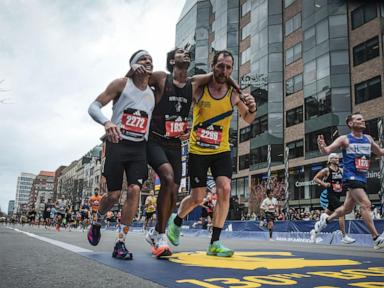
When the fatigue of 26.2 miles turns the human body into a collapsing stack of levers and pulleys, the instinct for self-preservation usually dictates a singular focus on the finish line. Yet, year after year, the Boston Marathon produces a specific, recurring image that defies the logic of competitive athletics. A runner, lungs burning and legs seizing, stops short of their own goal to hoist a complete stranger off the pavement. This isn't just a feel-good clip for the local evening news. It is a biological anomaly that challenges our understanding of the selfish gene.
The man who helped his fellow runner across the line in the most recent display of grit claimed it was "natural instinct." On the surface, that sounds like the humble deflection of a common hero. Under the microscope of sports psychology and evolutionary biology, however, that statement holds a weight that most observers miss. We are conditioned to view sports as a zero-sum game—a brutal calculation of pace, split times, and personal records. But at the edge of physical exhaustion, a different set of hard-wired circuits takes over.
The Neurological Bypass of Marathon Altruism
At the 25-mile mark, the brain is operating on emergency reserves. The prefrontal cortex, the seat of complex decision-making and logic, is dimmed by a lack of glycogen. In this state, a runner shouldn't be making "decisions" at all. They should be on autopilot. This is why the act of stopping to help a falling competitor is so significant. It isn't a calculated move designed to garner social media likes; it is a primal response triggered before the conscious mind can intervene.
Research into extreme physical stress suggests that when we witness someone else in pain, our mirror neurons fire with such intensity that the distinction between "self" and "other" begins to blur. For a marathoner who has spent four hours suffering in the same humidity and over the same asphalt as the person next to them, the empathy is literal. To see the runner next to you buckle is to feel your own legs buckle. Helping them isn't an act of charity so much as it is a desperate attempt by the brain to resolve a shared trauma.
Beyond the Hero Narrative
The media loves to frame these moments as a triumph of the human spirit, but that narrative often ignores the brutal physical cost. When a runner stops to lift someone else, they risk permanent injury. Their own muscles are already at the snapping point. By adding the dead weight of another person, they are overloading their skeletal structure at the exact moment it is most vulnerable.
There is also the matter of the clock. For many, Boston is the culmination of years of qualifying attempts. To sacrifice a personal best or a hard-earned finishing time for a stranger is an act of "atypical altruism." Most people think they would help, but the data on the "bystander effect" in high-pressure environments suggests otherwise. Most runners keep going. They look down, they feel a pang of sympathy, and they keep their eyes on the timing mat.
Those who stop represent a break in the standard psychological pattern. They possess what researchers call high "prosocial motivation," a trait that is often forged in high-stakes environments like the military or emergency services. It is no coincidence that many of the people who stop on Boylston Street have backgrounds in fields where leaving a teammate behind is the ultimate failure.
The Myth of the Natural Instinct
While the runner involved called his actions an instinct, we have to look at the cultural architecture of the Boston Marathon specifically. This race is not like a local 5K or even the New York City Marathon. Boston is a pilgrimage. The tragedy of 2013 transformed the finish line from a simple timing point into a sacred space of resilience.
Every runner who enters that final stretch is aware of the history. This awareness creates a "collective identity" that overrides individual ambition. In a standard race, you are competitors. In Boston, you are survivors of the course. This cultural layer provides the permission—and the social pressure—to abandon your own race for the sake of the collective. If you see someone fall five feet from the line where bombs once went off, the moral weight of that location makes it almost impossible to keep running.
The Physiological Price of the Final Assist
What happens to the body when you suddenly lift 170 pounds of failing runner after 26 miles? The physiological impact is catastrophic.
- Acute Muscle Tearing: The sudden transition from a rhythmic running gait to a lifting motion can cause Grade 2 or 3 tears in the hamstrings and lower back.
- Cardiac Strain: The heart is already redlining. Adding the isometric tension of a lift can cause dangerous spikes in blood pressure.
- The Adrenaline Dump: The "heroic" surge provides a temporary mask for the pain, but once the finish line is crossed, the crash is twice as severe.
We see the hug and the medal ceremony. We don't see the six months of physical therapy that often follow for the "helper." This is the hidden side of the story that the standard news cycle avoids because it complicates the feel-good ending. True altruism isn't free; it is a high-interest loan taken out against the body's future health.
Why We Need the Spectacle
In a world increasingly defined by digital isolation and competitive individualism, the image of two broken people crossing a line together serves as a necessary counter-signal. It reassures the public that, in the most extreme circumstances, our default setting is cooperation rather than competition.
But we must be careful not to sanitize the act. To call it "natural" almost cheapens the immense willpower required to fight the body's screaming demand to stop and save itself. It is a conscious rebellion against the survival instinct. The runner who helps isn't just following a whim; they are making a radical statement about the value of another human life in a moment when their own body is telling them that nothing matters except the end of the pain.
The Mechanical Reality of the Finish Line
The mechanics of the assist are often clumsy. You see arms draped over shoulders, the dragging of feet, the desperate leaning. There is no grace in it. This is raw, mechanical labor. The "helper" often has to coordinate their breathing with the person they are carrying, creating a synchronized unit that moves at a fraction of their previous speed.
This deceleration is the ultimate sacrifice in a sport measured by seconds. In the professional tiers, where sponsors and contracts are on the line, this almost never happens. The "natural instinct" seems to be inversely proportional to the amount of money at stake. This suggests that the purity of the act is found primarily in the amateur ranks—the people for whom the race is a personal test rather than a career.
The Long Road to Recovery
The cameras eventually turn away. The crowds go home. The "hero" and the "helped" are left to deal with the aftermath. For the person who was helped, there is often a complex mix of gratitude and "survivor's guilt"—the feeling that they didn't truly earn the medal. For the helper, there is the quiet return to a life where they may be nursing a back injury for months.
We shouldn't just celebrate these moments as "instinct." We should recognize them as a deliberate choice to be more than a biological machine. It is a refusal to be defined by a chip time. When a runner stops, they are declaring that the person next to them is more important than the goal in front of them. In a society that measures everything by the finish line, that is the most radical act possible.
Next time you see a runner collapse and another reach down, don't look at the medal. Look at the feet. Look at the way one person anchors themselves so another can move. That isn't just an instinct; it's a rejection of the idea that we have to run this race alone.
Stop looking for the hero in the headline and start looking at the grit in the gravel.



-1920w.jpg)