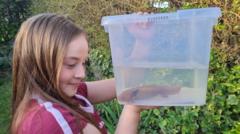
The discovery of a Mexican axolotl (Ambystoma mexicanum) within a freshwater system in Wales represents a significant failure of localized bio-security and an indicator of the "pet-to-wild" pipeline. While public discourse often frames such events through the lens of a "rare find" or a serendipitous discovery, a clinical analysis reveals a complex intersection of invasive species risk, thermal tolerance thresholds, and the breakdown of exotic pet trade regulations. This occurrence is not an isolated biological curiosity but a case study in anthropogenic environmental disruption.
The Mechanism of Introduction and Survival
The presence of a critically endangered Mexican salamander in a temperate Welsh stream necessitates a breakdown of the causal chain leading from controlled captivity to wild emergence. Unlike indigenous species that have evolved within the specific nutrient cycles and thermal regimes of the United Kingdom, the axolotl is endemic to a single high-altitude lake complex in Mexico: Lake Xochimilco.
Three distinct variables determine the probability of an exotic organism appearing in a non-native habitat:
- Market Accessibility: The axolotl has transitioned from a specialized laboratory model to a mass-market commodity within the exotic pet trade. Increased availability correlates directly with a higher frequency of accidental or intentional releases.
- Pathological Displacement: Owners often release specimens into local waterways when they encounter health issues (such as fungal infections) or when the maintenance cost-benefit ratio becomes unfavorable. This "discarding" behavior is a primary vector for invasive potential.
- Thermal Survival Windows: The axolotl is uniquely adapted to cool, oxygen-rich waters. While Xochimilco is a high-altitude environment, the Welsh climate offers a temporary thermal analog. During spring and autumn, the water temperatures in the UK align closely with the axolotl’s preferred range of 14°C to 18°C.
The Biological Profile of Ambystoma Mexicanum
To understand why this discovery is a concern for local biodiversity, one must evaluate the biological capabilities of the axolotl. It is a neotenic salamander, meaning it retains its larval features—including external gills—throughout its entire lifespan without undergoing metamorphosis. This specialized physiology creates specific environmental dependencies.
Respiratory Logic and Water Chemistry
Axolotls utilize four distinct methods of respiration: skin absorption, external gills, buccal pumping (throat membranes), and rudimentary lungs. This redundancy allows them to survive in varying levels of dissolved oxygen. However, their permeable skin makes them hyper-sensitive to water pollutants, particularly nitrates and heavy metals common in urban runoff under bridges. The survival of a specimen in a Welsh bridge pool suggests the water quality at that specific site met a minimum threshold of chemical stability, likely due to recent precipitation dilution.
Predatory Hierarchy
As obligate carnivores, axolotls occupy a high trophic level in their native habitat. In a Welsh ecosystem, they compete directly with native newts (Triturus cristatus) and small fish. Their feeding mechanism—a vacuum-based "gape and suck" method—is highly efficient for consuming aquatic invertebrates and small vertebrates. The introduction of such a predator, even as a single unit, disrupts the localized micro-ecology by predating on native larvae that lack evolved defense mechanisms against Mexican ambystomatids.
The Risks of Pathogen Transmission
The most significant threat posed by the presence of an axolotl in Welsh waters is not the individual animal, but the invisible cargo it carries. The global trade of amphibians is the primary driver of the spread of Batrachochytrium dendrobatidis (Bd) and Batrachochytrium salamandrivorans (Bsal).
- Bsal Vulnerability: This chytrid fungus is lethal to European salamander and newt populations. It causes skin ulcerations and rapid mortality.
- Vector Potential: Captive-bred axolotls are often asymptomatic carriers of these pathogens. Releasing a single specimen into a bridge pool creates a localized infection center, where the fungus can migrate through the water column to infect native UK newt populations.
- Ecosystem Collapse: A Bsal outbreak triggered by a released pet can lead to a 90% decline in local amphibian biomass within a single season, causing a cascade effect that impacts insect control and the prey base for local birds and small mammals.
Mapping the Regulatory Gap
The Welsh discovery highlights the insufficiency of the current regulatory framework governing exotic species. The legislative architecture currently focuses on "Invasive Alien Species of Union Concern," yet it often fails to account for "hobbyist-driven" introductions.
The failure occurs at three points in the supply chain:
- Point of Sale Education: Retailers rarely provide comprehensive data on the long-term ecological risks of release or the specific specialized care required to prevent "owner fatigue."
- Traceability: There is currently no mandate for microchipping or unique identification of sold axolotls, making it impossible to hold the original owner accountable for illegal dumping under the Wildlife and Countryside Act 1981.
- End-of-Life Infrastructure: Most regions lack "amnesty" programs where owners can surrender unwanted exotic pets without legal repercussions, leading to the bridge-release scenario.
Analyzing Neoteny as an Evolutionary Constraint
The axolotl’s refusal to "grow up" (metamorphosis) is an evolutionary trade-off. By remaining aquatic, it avoids the high energetic costs of developing terrestrial lungs and limb strength. However, this creates a biological bottleneck. In the context of a Welsh river, the axolotl is trapped. Unlike native newts, it cannot crawl out of the water to escape poor conditions or find a different pond.
If the water temperature rises above 24°C or drops toward freezing for an extended period, the specimen faces metabolic collapse. The discovery under a bridge is likely a result of the animal seeking a "thermal refuge"—the shade of the structure providing a cooler micro-climate than the open water.
Strategic Interventions for Bio-Security
The discovery of a Mexican axolotl in Wales should be treated as a red-team exercise for environmental agencies. The following tactical responses are required to mitigate future occurrences:
- Environmental DNA (eDNA) Surveillance: Implementing eDNA testing in waterways near high-density residential areas to detect the genetic signatures of non-native species before they establish breeding populations.
- Thermal Mapping of High-Risk Zones: Identifying "bridge pools" and slow-moving channels that provide stable thermal environments for tropical or sub-tropical escapees.
- Pathogen Screening Protocols: Any recovered non-native specimen must be quarantined and screened for Bsal and Ranavirus. The data must be used to map the "pathogen load" entering the UK via the pet trade.
The long-term survival of such a specimen in the wild is statistically low due to the UK's winter temperature profiles. However, the short-term ecological damage—specifically the risk of permanent fungal contamination of the watershed—is disproportionately high. The presence of the axolotl is a symptom of a larger systemic failure in how the transition from global trade to local ecology is managed.
Authorities must shift from a reactive "rescue" mindset to a proactive ecological defense strategy. This involves re-classifying popular exotic pets not just as animals, but as potential biological pollutants. The immediate strategic priority is the mandatory screening of the catchment area where this specimen was found to ensure no secondary contamination has occurred. If the fungal presence is detected, localized chemical sterilization of the water segment may be necessary to prevent a regional biodiversity collapse.