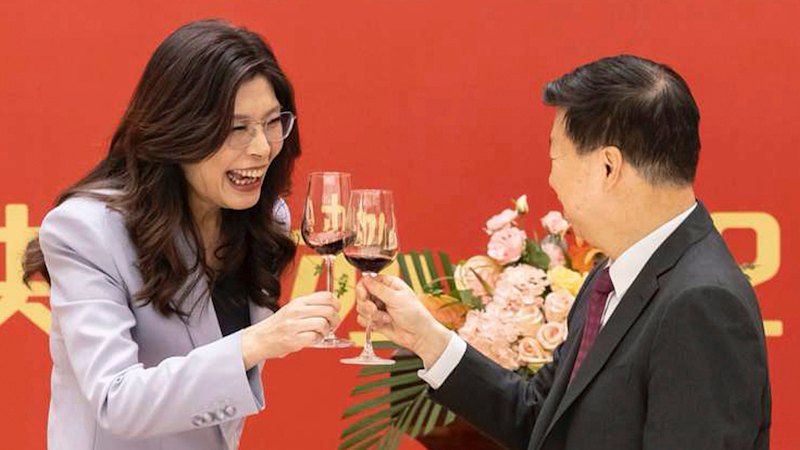
Beijing is currently executing a sophisticated political squeeze play, using the leader of Taiwan’s opposition to create a "fait accompli" before Donald Trump even touches down for his May summit with Xi Jinping. By hosting Kuomintang (KMT) Chairwoman Cheng Li-wun this week, the Chinese Communist Party isn't just seeking a photo op; it is attempting to lock in a narrative of "peaceful reconciliation" that effectively neutralizes Washington’s most aggressive leverage over the island.
The timing is surgically precise. Cheng, who assumed the KMT leadership in late 2025, is the first party chair to visit the mainland in a decade. Her presence at the Sun Yat-sen Mausoleum in Nanjing and her subsequent meetings in Beijing are designed to signal to the world—and specifically to the incoming Trump administration—that the "Taiwan problem" is a domestic Chinese issue already trending toward a quiet resolution. If Beijing can convince the White House that Taipei is willing to bargain, the strategic value of U.S. arms sales and high-level diplomatic visits begins to erode.
The Strategy of Internal Erosion
Beijing’s invitation to Cheng Li-wun is a masterclass in exploiting democratic friction. While the ruling Democratic Progressive Party (DPP) under President Lai Ching-te remains frozen out of communications by Beijing, the KMT is being positioned as the only adult in the room capable of preventing a kinetic conflict. This creates a devastating internal pressure in Taipei. By bypassing the elected government and dealing directly with the opposition, Xi Jinping is effectively vetoing the DPP’s mandate to manage cross-strait relations.
This isn't merely about political theater. The KMT delegation’s visit coincided with the party skipping critical defense budget discussions in the Legislative Yuan. This is the "why" that matters. By simultaneously engaging in peace talks in Beijing and stalling military spending in Taipei, the opposition is providing the CCP with a dual victory: a diplomatic narrative of "reconciliation" and a tangible weakening of Taiwan’s domestic defense posture.
Neutralizing the Trump Factor
Donald Trump’s return to the world stage brings a volatile brand of transactional diplomacy that Beijing deeply fears. Trump has already floated the idea of using Taiwan as a bargaining chip in trade negotiations, specifically targeting the $127 billion trade imbalance and Taiwan's dominance in the semiconductor industry.
The CCP's goal is to remove that chip from the table before the May summit. If Cheng Li-wun and Xi Jinping can produce a framework for "joint prosperity" or a "peace memorandum," Beijing can argue to Trump that U.S. interference is the only thing preventing stability. For a president who prioritizes "deals" over long-standing ideological commitments, a pre-packaged "peace" might look more attractive than a costly military standoff in the South China Sea.
The Silicon Shield Under Pressure
The economic component of this visit is frequently overlooked but remains the most vital factor. Taiwan’s semiconductor industry is the island’s primary life insurance policy. Beijing understands that if it can weave KMT-led business interests deeper into the mainland’s tech ecosystem, it can bypass the "Silicon Shield" entirely.
Cheng’s delegation includes industry figures who are wary of the aggressive decoupling pushed by Washington. They see the U.S. CHIPS Act and subsequent export controls not as protection, but as a slow-motion hollowing out of Taiwan’s economic engine. Beijing is playing on this anxiety, offering "special economic zones" and preferential treatment for Taiwanese firms that choose "reconciliation" over "confrontation."
A Calculated Risk for the KMT
Cheng Li-wun is walking a razor-thin wire. To the KMT’s aging base, she is a peacemaker preventing a catastrophic war. To the younger, more identity-conscious Taiwanese electorate, she risks looking like a collaborator.
History shows that these visits often backfire. In 2005, Lien Chan’s "journey of peace" helped stabilize relations but ultimately fueled the perception that the KMT was too close to Beijing, leading to their eventual electoral decline. Cheng is betting that the global instability of 2026—marked by regional conflicts and economic volatility—has made the Taiwanese public desperate enough for stability to forgive her proximity to Xi.
The Looming Deadlock
The immediate result of this outreach is a deepened paralysis within Taiwan’s government. President Lai’s administration is now forced to play defense, accusing the KMT of "surrendering" sovereignty while having no channel of its own to counter Beijing’s narrative.
Meanwhile, a bipartisan group of U.S. Senators is currently in Taipei, attempting to provide "reassurance" before the Trump-Xi summit. But their message is getting drowned out by the optics of Cheng and Xi shaking hands. Beijing has successfully turned Taiwan’s domestic democracy into an arena for its own strategic competition.
The real test will not be the communiqué released at the end of Cheng’s trip, but the silence that follows. If Beijing continues its military incursions while talking peace with the opposition, it proves the visit is a hollow exercise in distraction. However, if there is a temporary lull in "gray zone" tactics, it will be a clear signal that the CCP believes it has found a more effective weapon than missiles: the slow, methodical co-opting of its enemy’s political system.
Trump will arrive in Beijing to find a landscape where the "Taiwan card" has been significantly devalued by the Taiwanese themselves.