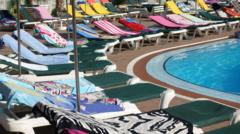
The air at 5:45 AM in Tenerife is thick with the scent of jasmine and chlorine. It is a quiet, heavy stillness that should be reserved for recovery and rest. But beneath the palms, a shadow moves. It is an accountant from Birmingham named Gary. Gary is not a criminal, nor is he particularly aggressive by nature. Yet, here he is, creeping toward the pool deck with four neon-green towels draped over his shoulder like ammunition belts.
He is a soldier in the "Dawn Dash." This is the invisible war of the all-inclusive resort, a desperate daily skirmish for a six-foot strip of mesh and plastic. Gary knows the rules of engagement. If he doesn’t place these towels now, his family will spend the afternoon huddled on the concrete or, worse, retreating to the balcony of their room.
This isn’t just about a place to sit. It’s about the scarcity of relaxation. It’s about the fear that a hard-earned vacation—three thousand pounds and a year of overtime—might be ruined by a ten-second delay in the lobby. But the tide is turning against Gary and his ilk. A landmark legal payout has forced the hand of the global hospitality industry, turning a mild annoyance into a high-stakes liability.
The Payout That Changed the Rules
For years, hotels looked the other way. They viewed the towel-strewn wasteland of empty chairs as a "guest behavior" issue—something to be handled with a polite sign or a shrug of the shoulders. That changed when the frustration boiled over into the courtroom.
A British holidaymaker recently won a settlement after a resort failed to manage the chaotic scramble for sunbeds. The argument was simple but devastating: the hotel had created a hazardous environment. By allowing—and even tacitly encouraging—a pre-dawn race over slippery tiles, they were responsible for the inevitable slips, falls, and physical altercations.
Money talks. When the "sunbed wars" shifted from a punchline in a tabloid to a line item in a legal budget, the corporate giants of travel finally woke up.
Consider the physics of the morning rush. You have hundreds of people, many in flip-flops, moving at high speeds toward a singular objective. Add a layer of morning dew or spilled sangria from the night before, and you have a recipe for a broken hip. The courts have now signaled that "first come, first served" is not a valid safety strategy.
The Psychology of the Towel
Why do we do it? Why does a rational human being wake up three hours before breakfast to claim a piece of furniture they won't actually use until noon?
Behavioral economists call this "loss aversion." The pain of losing out on a sunbed is twice as powerful as the joy of actually sitting in one. We aren't seeking comfort; we are defending against the indignity of being left out. It is a primal reflex triggered by the sight of a stack of folded towels.
In the mind of the traveler, the towel is a flag. It is a claim of territory. It represents a psychological safety net. "If I have the bed," the logic goes, "I have control over my happiness." But this "happiness" is a zero-sum game. For every towel Gary lays down, a family of four arriving at 10:00 AM feels a surge of resentment that poisons their morning.
Hotels are finally recognizing that this resentment is bad for the brand. A guest who spends their morning arguing with a lifeguard about a "reserved" chair is not a guest who is going to book again next year.
The New Enforcement Era
The solution is no longer a polite request. It is a tactical intervention.
Across the Mediterranean and the Caribbean, resorts are deploying "Sunbed Patrols." These are staff members equipped with digital timers and a mandate for ruthlessness. The protocol is clinical: if a bed is occupied by a towel but not a human for more than thirty minutes, the towel is confiscated.
The first time it happens, the shock is palpable. Gary returns from his buffet breakfast, plate piled high with lukewarm bacon, only to find his neon-green flags gone. His territory has been annexed.
- RFID Tracking: Some high-end resorts in Dubai are experimenting with towels embedded with microchips. If the towel stays stationary for too long without a corresponding "check-in" via a guest wristband, an alert is sent to pool security.
- The Booking App: Others are treating sunbeds like airline seats. You open an app at 8:00 AM, select your coordinates, and pay a premium for the "prime" locations near the swim-up bar.
- Physical Barriers: Many pools are now physically locked behind gates until a specific hour, preventing the 5:00 AM "stealth drops."
These measures are often met with fury. There is something deeply unromantic about booking a sunbed on an app. It strips away the illusion of freedom that a vacation is supposed to provide. Yet, it replaces chaos with a cold, predictable fairness.
The Human Cost of the Scramble
The real tragedy of the sunbed wars isn't the legal fees or the lost towels. It’s the erosion of the "vacation state of mind."
Imagine Sarah. Sarah is a nurse who has worked sixty-hour weeks for six months. She arrives at the resort on a Tuesday, desperate for the sound of the ocean and the heat of the sun. She walks to the pool at 9:30 AM. Every single chair—dozens of them—is covered in a towel. Not a single person is actually there.
She stands there, book in hand, feeling like an intruder in a space she paid to enjoy. That feeling of "not belonging" is what hotels are now fighting to erase. They realize that the "Dawn Dashers" are essentially hijacking the communal experience.
One resort manager in Mallorca, who asked to remain anonymous, described the scene as "Lord of the Flies with sunscreen." He recounted stories of guests moving other people's shoes, hiding towels in the bushes, and even physical shoving matches over a middle-row lounger.
"We had to act," he said. "The litigation was the trigger, but the atmosphere was the real casualty. You can't sell 'luxury' if your guests are acting like they're in a riot."
A New Definition of Luxury
We are moving toward a world where the "free-for-all" is a relic of the past. In its place, we see a more regulated, perhaps more sterile, version of leisure.
Is it better? For Sarah, the nurse, it is. She can wake up, have a coffee, and know that her allocated space is waiting for her. She doesn't have to participate in the 6:00 AM Olympics. For Gary, it’s a loss of "gaming the system." He can no longer ensure his family’s dominance through sheer will and a lack of sleep.
The invisible stakes of this transition are rooted in how we value our time. By pricing sunbeds or strictly enforcing time limits, hotels are putting a literal value on the "prime" spots. They are admitting that the pool deck is real estate, and like all real estate, it must be managed, protected, and insured.
The era of the neon-green towel flag is ending. The courts have ruled that the "dash" is a danger, and the accountants have ruled that unhappy guests are an expense.
Tomorrow morning, Gary might still wake up at 5:45 AM. He might still walk down to the pool, towels in hand. But he will likely find the gates locked, a camera watching his every move, and a sign informing him that his "claim" has no power here.
The sun will still rise over the Atlantic, the jasmine will still scent the air, but the blue plastic thrones are no longer up for grabs. Peace, enforced by policy and a fear of lawsuits, has finally come to the poolside. It is a quiet victory, born of a broken system, leaving us all a little more organized, a little more regulated, and perhaps, finally, able to sleep in.
The towel on the chair was never about the sun. It was about the fear of being left behind. Now that the rules have changed, we are forced to confront the fact that we are all sharing the same small patch of paradise, and no amount of neon fabric can change that.