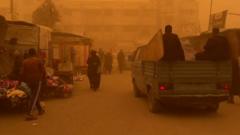
The convergence of a high-intensity sandstorm and an active kinetic conflict creates a compound disaster that exceeds the sum of its individual stressors. In Gaza, the arrival of desert-origin particulate matter—characterized by an orange hue indicating specific iron oxide concentrations—does not merely reduce visibility; it serves as a force multiplier for respiratory failure, mechanical degradation, and the total paralysis of remaining logistical corridors. The primary bottleneck for survival in this environment is the intersection of air quality index (AQI) spikes and the systemic destruction of sheltering-in-place capacity.
The Physics of Orange Skies: Particulate Composition and Human Impact
The orange tint observed in the Gazan atmosphere is the result of Mie scattering, where the diameter of suspended dust particles is similar to the wavelength of visible light. Unlike standard urban smog, sandstorm particulates (primarily $PM_{10}$ and $PM_{2.5}$) are geogenic. In a territory with a compromised healthcare ratio—measured by available ventilators per 100,000 residents—this atmospheric event triggers a predictable surge in acute respiratory distress syndrome (ARDS).
Three distinct biological vectors define the hazard:
- Mechanical Irritation: Large $PM_{10}$ particles settle in the upper airways, causing immediate inflammation and mucus hypersecretion.
- Systemic Absorption: $PM_{2.5}$ particles penetrate the alveolar-capillary barrier, entering the bloodstream and triggering systemic pro-inflammatory responses.
- Pathogen Hitchhiking: Dust particles often act as transport vectors for fungi and bacteria. In a conflict zone with broken sewage systems and unburied debris, the risk of secondary bacterial pneumonia increases exponentially as dust settles on exposed biological waste.
The Structural Vulnerability of Displacement Shelters
The directive for civilians to "seek shelter" assumes the existence of a sealed envelope. In the current Gazan context, the building stock is characterized by varying degrees of structural compromise. The efficacy of a shelter during a sandstorm is measured by its Air Change per Hour (ACH) rate.
- Intact Concrete Structures: These offer the highest protection, provided windows are sealed with non-porous materials.
- Modified Tents and Plastic Sheeting: These provide near-zero filtration. Standard polyethylene sheeting used in humanitarian aid lacks the micron-level weave necessary to block $PM_{2.5}$.
- Compromised Buildings: Structures with shrapnel damage or partial collapses experience "chimney effects," where wind pressure differentials pull dust deep into interior rooms, rendering them as hazardous as the exterior environment.
The thermal regulation of these shelters creates a secondary crisis. High particulate density often correlates with stagnant, high-pressure weather systems. Without active HVAC or mechanical ventilation—both of which require a stable power grid—occupants face a choice between heat exhaustion in a sealed room or respiratory damage in an ventilated one.
Mechanical Attrition and Logistical Paralysis
Sandstorms exert a brutal tax on mechanical systems. The silicon dioxide ($SiO_2$) content in desert sand is highly abrasive, leading to rapid degradation of moving parts.
The Filter Clogging Function
The rate of failure for internal combustion engines (ambulances, water pumps, generators) follows a non-linear curve during a storm. As the dust concentration ($C$) increases, the time to filter saturation ($T_s$) decreases according to the efficiency of the intake system. In makeshift or poorly maintained vehicles, the result is total engine seizure within hours of operation.
Communication and Navigation Failure
High concentrations of suspended dust attenuate electromagnetic signals. This creates a "gray-out" for both optical sensors and radio frequency (RF) communications.
- Visual Impairment: Horizontal visibility drops below 10 meters, halting the movement of aid convoys.
- Signal Degradation: Scattering of signals affects the low-power VHF/UHF radios often used by emergency responders, leading to a breakdown in tactical coordination.
The Healthcare Logistical Bottleneck
The storm shifts the medical burden from trauma (kinetic injuries) to internal medicine (respiratory and cardiovascular events). This shift is catastrophic for a system optimized for surgery and wound care. The lack of clean water exacerbates the issue; hydration is a primary defense against dust-related illness, yet the energy required to desalinate or pump water is often unavailable due to the aforementioned mechanical attrition of generators.
Strategic Mitigation and Necessary Response
Surviving the intersection of a sandstorm and conflict requires a pivot from passive sheltering to active particulate management.
- Prioritize the "Inner Room" Strategy: Civilians must identify the room with the fewest exterior walls. Sealing gaps with damp cloth is more effective than dry cloth, as moisture increases particle adhesion through capillary bridges.
- Mechanical Preservation: All non-essential power generation must be deactivated until the storm passes to prevent permanent engine damage. Essential generators require "pre-filter" wraps—improvised layers of dense fabric that can be swapped or shaken out frequently.
- Fluid Rationing: Medical protocols must prioritize the distribution of saline and oral rehydration salts to combat the drying of mucosal membranes, which is the body’s first line of defense against infection.
The duration of the storm dictates the mortality rate. A 24-hour event is a logistical hurdle; a 72-hour event is a mass-casualty driver. The immediate strategic requirement is the deployment of high-efficiency particulate air (HEPA) kits to centralized medical hubs, though the lack of a stable electrical load remains the primary failure point in the survival chain.