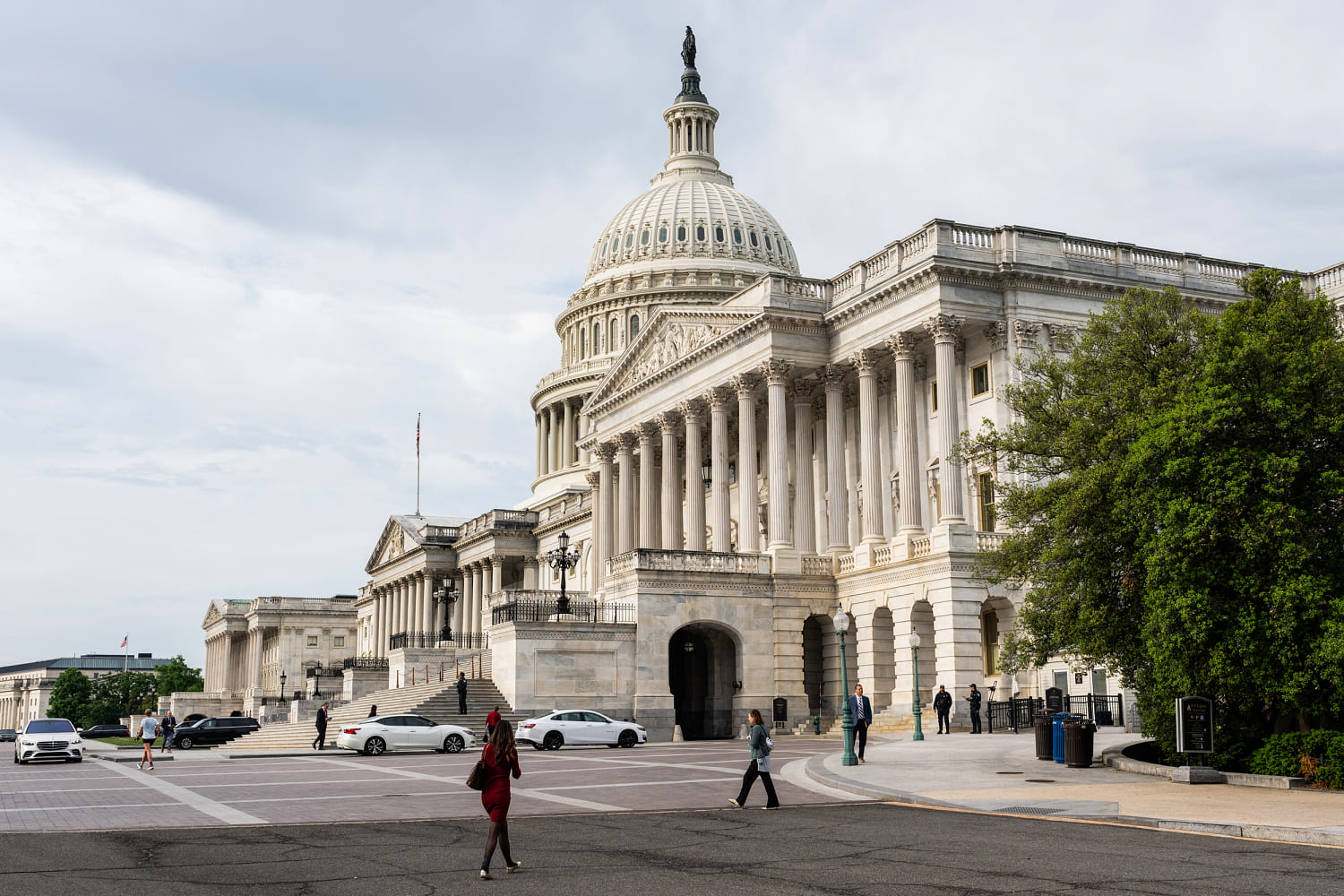
The recent Senate Republican move to advance a budget measure specifically targeting Immigration and Customs Enforcement (ICE) and Customs and Border Protection (CBP) represents more than a partisan maneuver; it is a tactical utilization of the Budget Reconciliation Process. This mechanism allows for the bypass of the 60-vote filibuster threshold, transforming a standard spending bill into a high-leverage policy instrument. To understand the implications of this funding surge, one must analyze the three structural pillars of border enforcement: Personnel Scalability, Technological Interdiction, and Judicial Throughput.
The current legislative push focuses heavily on the first two, yet the efficacy of any border security model is fundamentally limited by the weakest link in the operational chain. If the Senate measure funds more agents (Personnel) and more sensors (Technology) without a proportional increase in processing capacity (Judicial), the system experiences a bottleneck effect, where the cost per apprehension rises while the rate of final case resolution plateaus. Recently making headlines recently: Why Iran is Flexing Muscle in the Strait of Hormuz Right Now.
The Fiscal Mechanics of Personnel Expansion
Expanding the workforce of ICE and CBP is the most capital-intensive component of the proposed measure. Unlike technological investments, which have high upfront costs but lower marginal maintenance costs, personnel expenditures create long-term fiscal obligations through salaries, benefits, and pension liabilities.
The Senate resolution aims to close the "Staffing Gap," defined as the delta between current operational capacity and the manpower required to maintain 24/7 surveillance across all sectors. However, the logic of "more boots on the ground" ignores the diminishing marginal returns of human patrols in difficult terrain. Further details into this topic are explored by BBC News.
- The Training Lag: There is a documented six-to-twelve-month delay between budget appropriation and field deployment. This is caused by the rigorous vetting, physical training, and legal education required for federal law enforcement.
- The Retention Variable: Increasing headcount in a high-stress environment often leads to higher attrition rates if not paired with mid-level management reform. Without addressing retention, the new funding serves merely to replace exiting veterans with less experienced recruits, neutralizing the intended increase in operational expertise.
Interdiction Technology and the Data Saturation Problem
A significant portion of the budget measure is earmarked for autonomous surveillance towers (ASTs), drones, and non-intrusive inspection (NII) systems at ports of entry. The strategy here shifts from physical barriers to a "Virtual Wall" framework.
The primary objective of NII technology is to increase the "Scan Rate"—the percentage of commercial vehicles inspected for contraband without slowing the flow of trade. At present, only a fraction of incoming cargo is scanned. The proposed funding seeks to move this toward a 100% scan environment. However, this creates a secondary crisis: Data Saturation.
The hardware produces petabytes of visual and sensor data that require either human review or advanced algorithmic processing. If the budget does not allocate specific funds for the backend IT infrastructure and AI-driven analysis tools, the hardware remains "dark," collecting information that no one has the bandwidth to act upon. The relationship between sensor deployment ($S$) and interdiction success ($I$) is not linear; it is mediated by the processing capacity ($P$).
$$I = f(S \cdot P)$$
If $P$ remains constant while $S$ increases, the return on investment for the Senate’s budget measure will approach zero.
The Judicial Bottleneck and the Enforcement Gap
The most glaring omission in many enforcement-heavy budget resolutions is the lack of funding for the Executive Office for Immigration Review (EOIR). While the Senate measure funds the "Front End" of the system (apprehension and detention), it frequently neglects the "Back End" (adjudication).
The result is a surge in the Case Backlog. When an individual is detained by ICE, they enter a legal queue. If the number of immigration judges does not scale in tandem with the number of enforcement officers, the duration of detention increases. This leads to:
- Exploding Detention Costs: Maintaining an individual in a federal facility is a daily recurring cost. Longer wait times for hearings directly inflate the ICE operational budget.
- The "Catch and Release" Necessity: When detention facilities reach their statutory or physical capacity, the government is forced to release individuals into the interior with a "Notice to Appear" (NTA). This undermines the primary deterrent intent of the budget measure.
A data-driven strategy would prioritize a 1:1 funding ratio between enforcement officers and judicial processing units to ensure the system remains fluid.
Detention Infrastructure and the Private Contractor Variable
The Senate measure allocates substantial funds for bed space. The logistics of detention are increasingly reliant on third-party contractors, which introduces a Cost-Plus Pricing Model into federal enforcement.
Private contractors often bill the government based on capacity rather than usage. This creates a "Guaranteed Minimum" payment structure. From a strategic standpoint, this ensures that infrastructure is available during a surge, but it also creates a high "Burn Rate" during periods of lower migration. The Senate’s move to lock in higher funding levels for detention beds serves as a hedge against future volatility, but it also tethers the federal budget to private sector profit margins that are historically difficult to renegotiate.
Logistical Reality vs. Political Signaling
The advancement of this budget measure is a masterclass in Legislative Signaling. By framing the bill around ICE and the Border Patrol, proponents are shifting the public discourse from "policy reform" to "operational funding."
However, the efficacy of the measure is threatened by the Appropriations Friction. Passing a budget resolution is the first step, but the actual release of funds requires specific appropriations bills. If the House and Senate cannot agree on the granular details of these bills, the resolution remains a "paper tiger"—a statement of intent without the legal authority to spend a single dollar.
The second friction point is Executive Discretion. Even if Congress mandates the funding, the Executive Branch (The Department of Homeland Security) has significant latitude in how those funds are deployed. For example, money earmarked for "Border Technology" could be spent on high-altitude sensors or low-range handheld devices, each yielding vastly different strategic outcomes.
Operational Recommendations for Maximum Interdiction
To transform this budget measure from a political win into a functional success, the deployment of funds must follow a Heuristic of Integrated Security:
- Implement a Tiered Surveillance Architecture: Prioritize ASTs in high-traffic corridors to funnel migration toward "Hardened Points" where personnel density is highest.
- Decouple Processing from Detention: Shift funding toward rapid-adjudication centers located at the border. By resolving cases within 72 hours of apprehension, the government can eliminate the long-term detention costs that currently drain the ICE budget.
- Audit the Contracting Framework: Move away from guaranteed-minimum contracts with private detention providers in favor of "Flex-Capacity" models that scale based on real-time border encounters.
The strategic play here is not simply to spend more, but to rebalance the ratio between apprehension, detention, and adjudication. Without this equilibrium, the Senate's budget resolution will result in a more expensive version of the current stalemate, where increased inputs (funding and personnel) fail to produce increased outputs (border stability and legal clarity). The focus must remain on the Throughput Metric—the speed and legality with which an individual case is closed—rather than the raw number of individuals detained.